
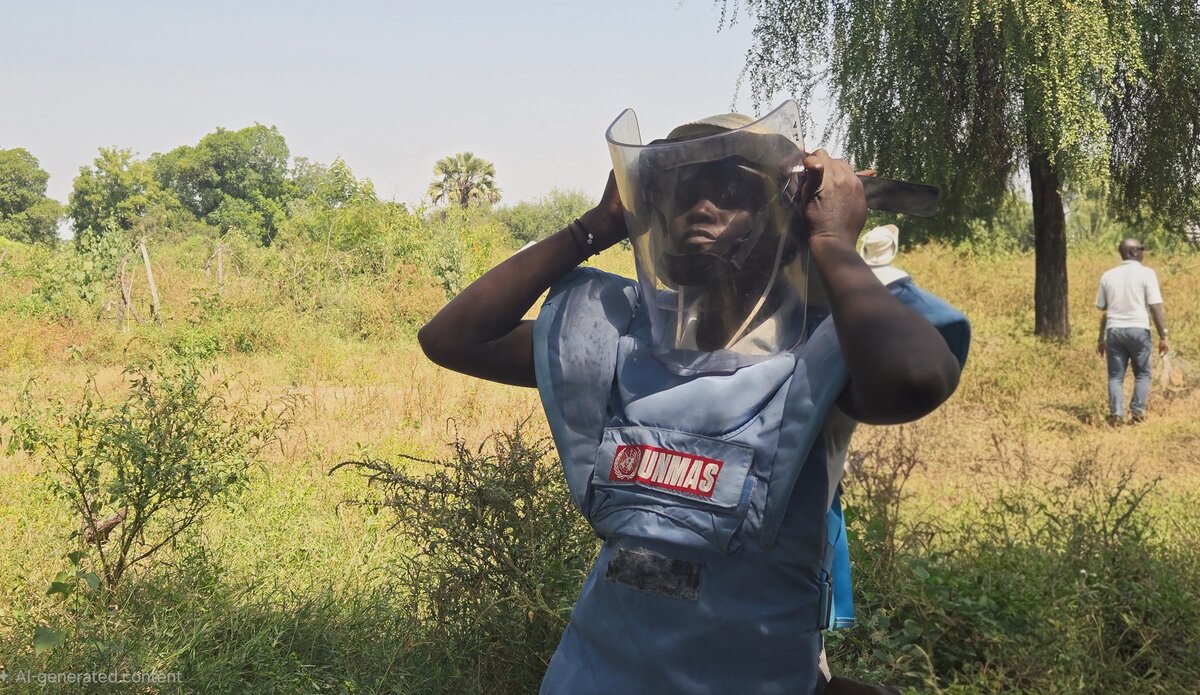
Mine action has historically drawn its explosive ordnance disposal technical expertise from male-dominated military and police backgrounds, resulting in persistent gender imbalances within the workforce. In South Sudan, UNMAS has been actively working with the National Mine Action Authority (NMAA) and sector partners for several years to address these structural barriers through sustained gender-responsive programming and institutional reform.
In 2025, these long standing efforts were further consolidated and elevated through a set of mutually reinforcing initiatives that together contribute to creating a conducive environment for women's career progression and tackle persistent invisible barriers: the launch of South Sudan’s first Gender Equality and Diversity (GED) Policy for Mine Action, the establishment of the Women in Mine Action Network (WiMAN), and the strengthening of Protection from Sexual Exploitation, Abuse and Harassment (PSEAH) systems across the sector.
Two Perspective on Gender in Mine Action
Gender in mine action is best understood through two distinct but interconnected lenses. The first concerns how mine action activities are delivered to affected communities. While explosive ordnance hazards themselves do not discriminate by sex or gender, people do. Socially assigned gender roles shape movement patterns, daily activities, and livelihoods for women, men, girls, and boys, directly influencing risk profiles and exposure to explosive ordnance. These considerations have long been mainstreamed into mine action planning and operations, such as survey, clearance, risk education, for land release are essential to ensuring that interventions are effective and benefit everyone, regardless of age or gender.
The second perspective, and the focus of the initiatives presented in this article, relates to gender equality, safeguarding, and employment conditions within the mine action workforce itself. While the sector remains overwhelmingly male-dominated, particularly in technical and leadership roles, UNMAS South Sudan has actively pursued practical measures to shift this balance. Under UNMAS-contracted projects, minimum participation targets were applied, resulting in approximately 30% of operational staff being women, alongside deliberate efforts to increase the deployment of women in managerial positions such as Project Managers and Team Leaders. These measures help to address not only cultural and social barriers, but also structural constraints linked to recruitment pipelines, training requirements, and historical reliance on male dominated military and police backgrounds, translating policy commitments into concrete workforce change.
Progress and Persistent Gaps in Workforce Inclusion
While challenges remain, it is equally important to acknowledge that the sector has come a long way. In South Sudan, women were entirely absent from operational mine action roles in 2004. Since then, sustained efforts by national authorities, operators, and partners, including early initiatives such as the training of the first female deminers by Norwegian People’s Aid, have gradually expanded opportunities. By the end of 2024, nearly 170 women were employed in operational mine action roles across the country. However, significant reductions in funding across the sector throughout 2025 have had a pronounced impact on staffing levels, resulting in a sharp decline in women’s employment. As of 2026, 77 women remain deployed out of a total operational workforce of 285, representing approximately 27% of all deminers, team leaders, and other field personnel. This progress has been underpinned by increasingly robust gender, diversity, and inclusion policies, guidelines, and standards. National Technical Standards and Guidelines require operators to tailor activities to the specific needs of women, men, girls, and boys, to field gender-balanced teams where possible, and to respect cultural norms while ensuring inclusive opportunities. South Sudan’s mine action strategies have consistently integrated gender considerations, emphasising sex- and age-disaggregated data collection and gender mainstreaming in planning and implementation.
Yet numerical representation alone is not enough. Without supportive working environments, clear accountability mechanisms, and pathways for leadership development, gains risk remaining fragile. Addressing these structural barriers is central to UNMAS’ current approach.
Establishing a Gender Equality and Diversity Policy Framework
A major milestone was the development and launch of South Sudan’s first Gender Equality and Diversity (GED) Policy for Mine Action. Developed by the Geneva International Centre for Humanitarian Demining (GICHD), with strong technical, logistical, and coordination support from UNMAS, the policy provides a comprehensive framework for promoting inclusive participation, equitable service delivery, fair employment practices, and institutional accountability across the sector.
The GED Policy guides mine action operators in embedding gender equality and diversity principles into recruitment, training, operational planning, and leadership structures. It aligns with the National Mine Action Strategy (2024–2028) and reinforces South Sudan’s commitments under key international and national frameworks, including the Anti-Personnel Mine Ban Convention (APMBC), the Convention on Cluster Munitions (CCM), UN Security Council Resolution 1325 on Women, Peace and Security, the Convention on the Elimination of All Forms of Discrimination against Women (CEDAW), the Convention on the Rights of Persons with Disabilities (CRPD), the Sustainable Development Goals, South Sudan’s National Gender Policy, and the National Action Plan on Women, Peace and Security (2023–2027).
The official launch convened national authorities, operators, donors, and partners, reaffirming a shared commitment to advancing a more inclusive and accountable mine action sector. Related content
Amplifying Women’s Voices through Networking
Complementing the GED Policy, UNMAS led the establishment of the Women in Mine Action Network (WiMAN) as a practical mechanism for translating policy commitments into practice. Emerging from recommendations identified during a sector-wide sensitization workshop for female deminers in February 2024, the network responds directly to the realities faced by women in mine action, many of whom work in remote locations and encounter persistent structural barriers to advancement, particularly in technical and leadership roles. WiMAN provides a structured platform for South Sudanese women in mine action to connect across organisations and locations, share experiences, access peer support, and strengthen professional development, while fostering solidarity and a shared sense of purpose in a physically demanding and highly technical sector.
Reflecting on the importance of the network, Agnes Chandia, Deputy Team Leader with UNMAS contractor SafeLane Global and Chair of WiMAN, highlighted the value of collective voice and connection across locations:
“As women, we all face unique challenges, and it’s important that our voices are heard. That’s why we advocated for this network, to create a space where we can share our experiences and find solutions together. We may be in different locations, but through this network, I know we will stay connected.”
As the first network of its kind within the global mine action sector, WiMAN remains at an early stage of development. Nevertheless, it has already demonstrated its value as a platform for amplifying women’s voices, promoting mutual learning, and creating pathways for participation and leadership. By linking women across geographic and institutional divides, the network has begun to address long-standing gaps in representation and visibility, while strengthening collective confidence and professional identity.
The establishment and launch of WiMAN was a collaborative effort, reflecting both the recognised need for such a platform and the strong commitment of stakeholders across the sector. The network is endorsed by the NMAA and supported by the Mine Action Area of Responsibility (AOR), international non-governmental organisations (MAG, DCA, DRC), and key partners including the Geneva International Centre for Humanitarian Demining (GICHD) and the Gender Affairs Unit (GAU) of the United Nations Mission in South Sudan (UNMISS). This collective engagement underscores a shared commitment to advancing gender equality in mine action and sustaining WiMAN as a nationally owned, inclusive mechanism for strengthening women’s participation and leadership over the long term. Related content
Strengthening PSEAH and Safeguarding
Alongside efforts to advance gender equality and women’s leadership, UNMAS has prioritised safeguarding through a strengthened Protection from Sexual Exploitation, Abuse and Harassment (PSEAH) approach that emphasises practice, care, and accountability over procedural compliance alone.
Since 2024, UNMAS has invested in building internal and partner capacity through Training of Trainers initiatives, enhanced PSEAH requirements in Third-Party procurement processes, targeted engagement with contractor leadership, and ongoing field-level sensitisation. In-person follow-up at operational level has confirmed that these efforts are being translated into practice, with increased confidence among personnel to raise safeguarding concerns and greater clarity on conduct expectations, protective measures, and reporting channels. This is further reinforced through the systematic display of PSEAH visibility materials, including posters in offices and field locations, which serve as continuous reminders of expected standards of behaviour, survivor-centred principles, and available reporting pathways.

UNMAS’ PSEAH engagement is hands-on and participatory. Three-hour introductory sessions are delivered in person to all operational teams and designed to encourage interaction, discussion, and reflection. This approach has proven effective in deepening understanding of standards of behaviour, individual responsibilities, and reporting mechanisms, while addressing common myths and misconceptions related to “natural” behaviour, gender roles, and fears of false allegations.
Embedding Safeguarding in National Standards and Moving Forward
To ensure sustainability, UNMAS supported the integration of safeguarding into the sector’s regulatory framework through the inclusion of a Technical Note on PSEAH Minimum Recommendations in the revised National Technical Standards and Guidelines. While not mandatory, the Technical Note strongly influences how operators implement sector standards in practice by translating policy commitments into clear operational guidance applicable to all mine action organisations and personnel in South Sudan. Related content
Safeguarding has also been reinforced through the integration of PSEAH considerations into External Quality Assurance (EQA) processes. EQA forms now systematically capture compliance with safeguarding standards, including awareness, prevention measures, reporting mechanisms, and conduct in the field. This strengthens accountability by ensuring that PSEAH is assessed alongside technical performance and embedded within routine oversight and quality assurance mechanisms across the sector.

UNMAS recognises that there is no single solution to achieving full gender equality in mine action. Deeply rooted structural, cultural, and capacity-related barriers persist, and progress requires sustained effort over time. Nevertheless, the GED Policy, the establishment of WiMAN, strengthened PSEAH systems, and the integration of safeguarding into national standards represent mutually reinforcing steps.
Through continued partnership with the NMAA and mine action stakeholders, UNMAS remains committed to ensuring that mine action in South Sudan not only removes explosive ordnance threats, but also advances dignity, equality, and long-term peace and recovery for all.
None of this would have been possible without the strong support and collaboration of GICHD, mine action stakeholders, including national and international NGOs, and the NMAA, whose trailblazing and outstanding commitment has been instrumental to this progress.