
In Gaza, Where Every Step Can Be Deadly, Disability-Inclusive Humanitarian Mine Action Saves Lives
On 22 June 2025, as displaced families gathered in the street to learn how to keep their children safe from explosive hazards, 43-year-old father Nimr approached an UNMAS-trained Risk Education Officer with a story he felt compelled to share.
Only months earlier, on 13 February, Nimr’s 12-year-old son Mahmoud had been playing in an open area near their home in Deir al Balah. Among the rubble, he found a small, circular metal object. Innocently, like so many curious children would do, he bent down to pick it up. It exploded in his hand.
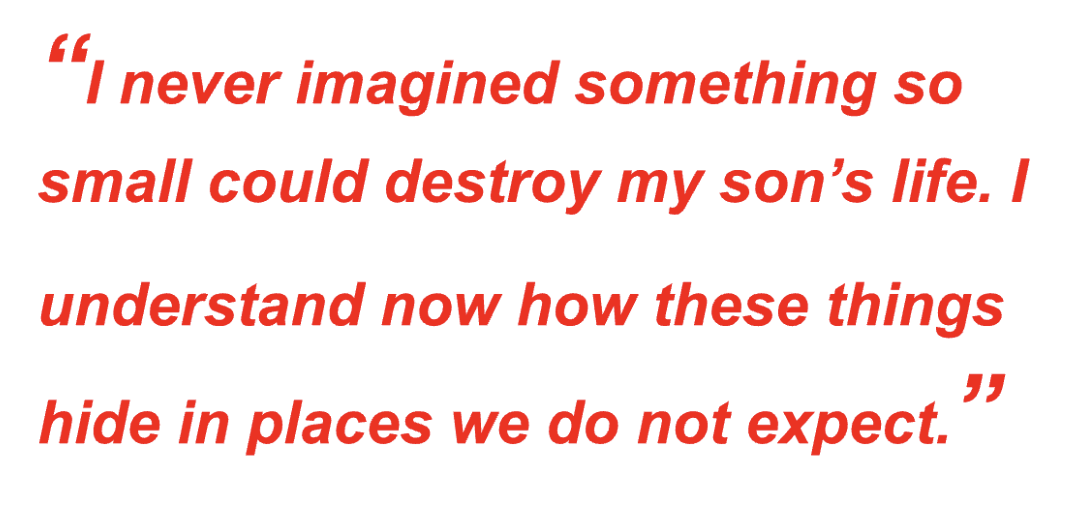
Mahmoud suffered severe burns to his face, right hand and left leg. When the family was displaced soon after, they struggled to find the urgent and ongoing treatment he needed in a health system that was no longer functioning. Standing in the street in Deir al Balah, Nimr said quietly, “I never imagined something so small could destroy my son’s life. I understand now how these things hide in places we do not expect.”
A growing disability crisis in Gaza
Rehabilitation centres have been destroyed or closed, mobility devices have been lost, and specialized medical and support services are often inaccessible. Local disability organizations consistently describe the situation as catastrophic. Many persons with disabilities cannot evacuate dangerous areas because they lack wheelchairs, prosthetics or caregiver support. Others are sheltering in damaged buildings that may be contaminated with explosive remnants.
These overlapping risks make disability-inclusive humanitarian mine action both urgent and lifesaving. Through tailored “Explosive Ordnance Risk Education” and “Conflict Preparedness and Protection” awareness-raising sessions, and comprehensive Victim Assistance processes (such as medical referrals, psychosocial support, shelter, and socio-economic assistance), humanitarian mine action organizations can prevent more tragic accidents and ensure that those who are impacted by explosive ordnance receive the critical medical and psychosocial support they need.
Why disability-inclusive safety education matters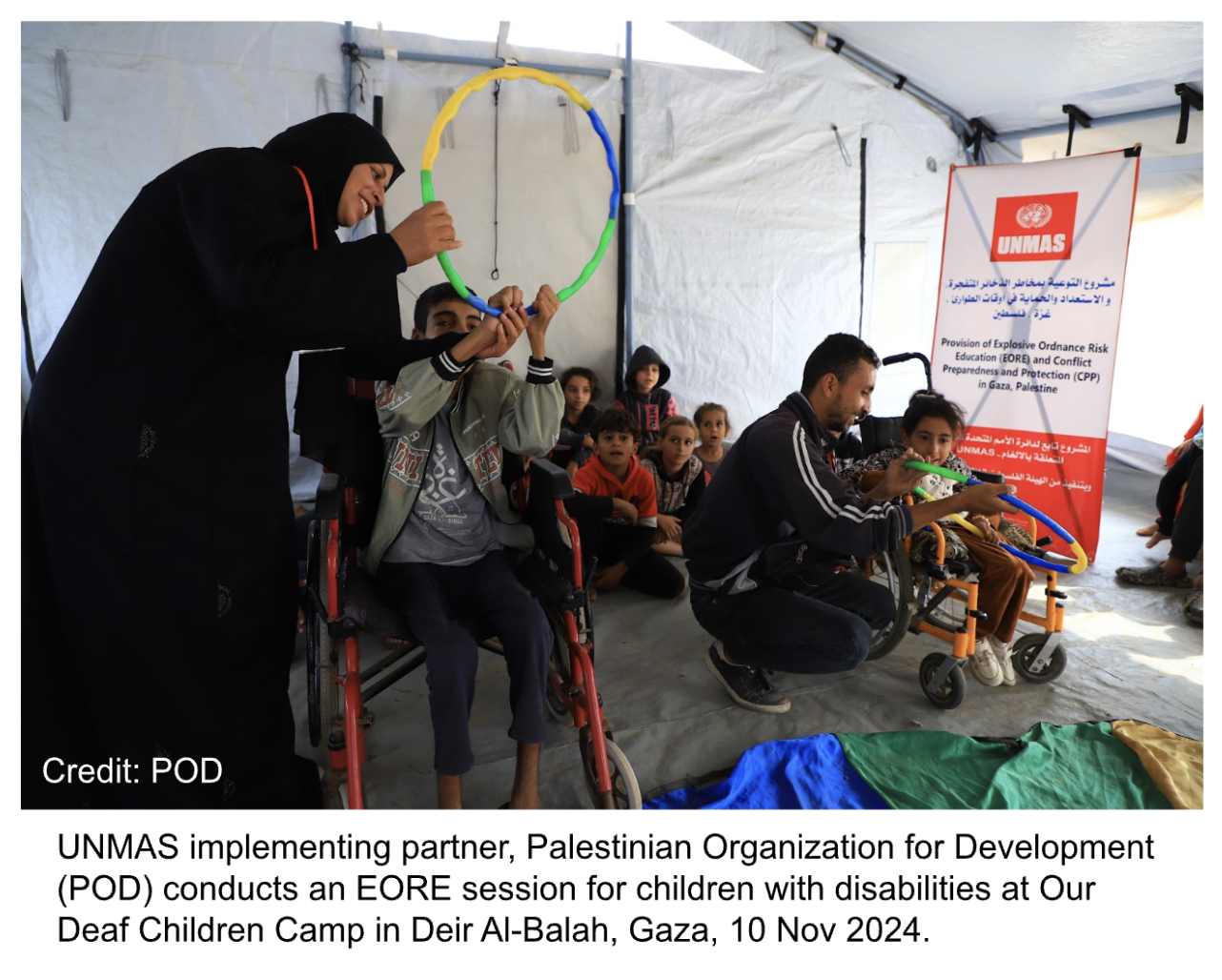 Many people with disabilities are more exposed to explosive hazards. For instance, people with limited mobility cannot always avoid rubble or unsafe ground. Those who have lost sight or hearing struggle to detect danger or follow warnings. Individuals with cognitive or psychosocial disabilities may find it difficult to interpret fast-changing, unfamiliar environments. Caregivers, already overburdened, often face impossible choices between seeking assistance or staying with a family member who depends on them.
Since October 2023, UNMAS and partners have delivered life-saving safety information to shelters, camps, health points and communities uprooted by conflict. Recognising that many persons with disabilities cannot attend large group sessions, facilitators have adapted their approach. They now provide smaller and more accessible activities, caregiver-focused guidance, and materials such as audio messages, SMS alerts, pictorial leaflets, and high-contrast posters.
UNMAS is committed to reaching everyone, especially those who face the greatest barriers.
Led by lived experience
Across Gaza, children who survive explosive incidents often become powerful voices in their own communities. Ten-year-old Moatasem is one of them. Displaced from Rafah and living in a makeshift shelter in Khan Younis, he found a small metal object near the tents, something that looked to him like a large screw. Not knowing the danger, he picked it up with pliers. It exploded instantly.
The blast changed his life. Moatasem lost the fingers on his left hand and required emergency surgery to remove part of his intestines. “I am afraid to touch anything now,” he told the safety educator. “I remember what happened every day.”
Despite the trauma, he now warns his friends never to touch unfamiliar objects, hoping that no one else makes the same mistake.
Stories like his show why people with disabilities must be at the centre of risk education. Across Gaza, UNMAS works with facilitators and volunteers who live with the consequences of explosive ordnance, including those who have lost limbs, hearing, sight, or mobility. When they speak, children listen. Their lived experience makes safety messages real and relatable.
They are not only survivors, but they are also leaders who protect their own communities.
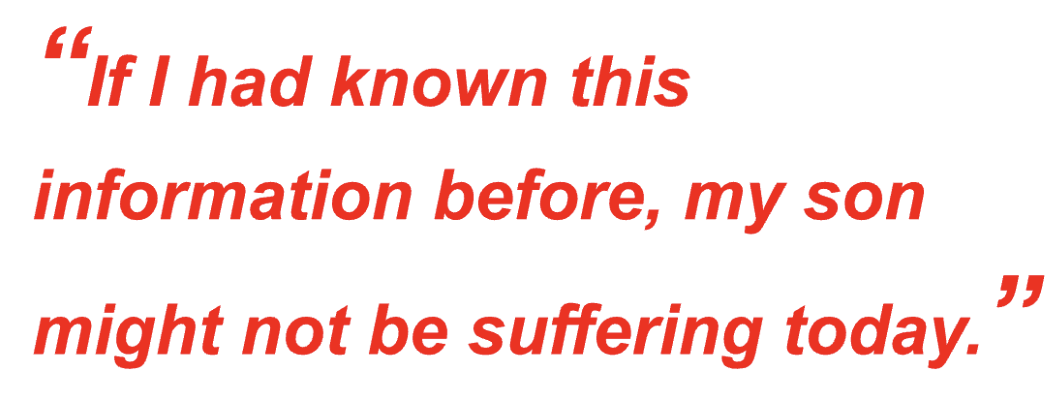 Explosive hazards will remain in Gaza long after the fighting stops. As communities rebuild, UNMAS is committed to ensuring that persons with disabilities and their caregivers are not only protected but also empowered to lead recovery efforts. They help shape training, inform planning, and guide the messages that keep families safe. Nimr’s words after his son was injured reflect the fear of many parents across Gaza: “If I had known this information before, my son might not be suffering today.”
After the blast: providing lifesaving support 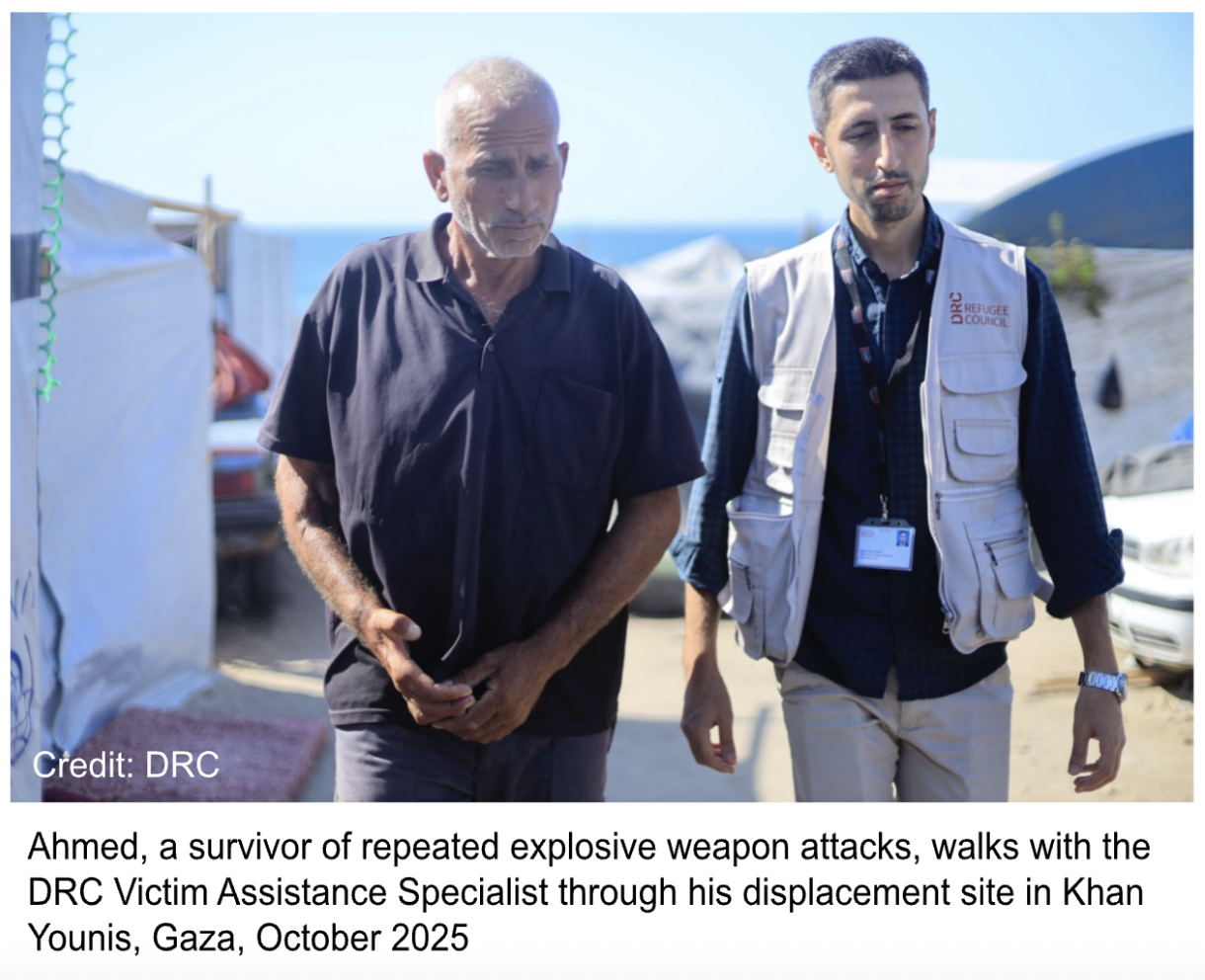
For children like Mahmoud and Moatasem, who have suffered life-changing injuries from explosive ordnance, Victim Assistance is designed to provide tailored, life-saving support to survivors from the moment that accidents are reported throughout the longer-term process of medical, psychosocial, and economic recovery. Most of the accidents reported relate to injury rather than death, leaving survivors in urgent and sustained need of care and protection. Yet, the real magnitude is still not captured. The Danish Refugee Council (DRC) recently identified 670 additional victims of Explosive Ordnance (EO), the use of Explosive Weapons in Populated Areas (EWIPA), and Small Arms and Light Weapons (SALW) through site-level household assessments across 21 displacement locations. This confirms severe under-reporting and systemic gaps in early identification and assistance.
From reporting to response
Once UNMAS receives a victim report through its online system, DRC steps in, conducting a comprehensive individual assessment, service mapping (identifying available services and how to access them), and coordinated referral to medical care, psychosocial support, shelter, and socio-economic assistance. Currently, Victim Assistance actions include case management as well as cash support, which is aligned with International Mine Action Standards, empowering those with life-changing injuries to navigate the impact of these accidents.
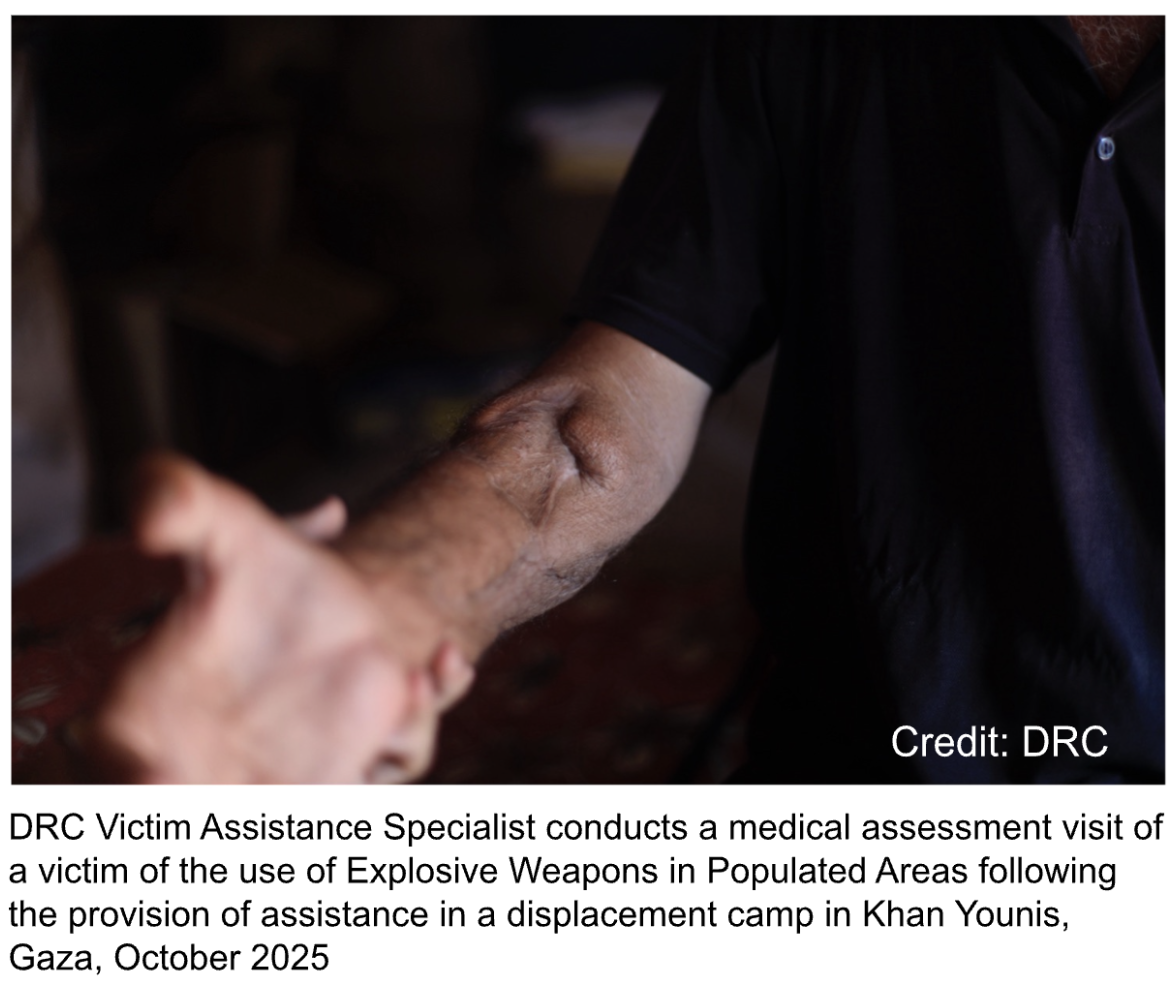 Behind each statistic is a deeply human story. Ahmed, an elderly man, was wounded multiple times: four separate conflict-related injuries between January 2024 and June 2025 have resulted in permanent functional loss of his dominant arm, embedded fragments, chronic pain, and severe economic vulnerability. Displaced with seven relatives, he now lives in an overcrowded tent and cannot access the specialized surgery he requires. He received a one-off cash grant from DRC, which he used to purchase medication, food, and hygiene supplies, as well as mattresses for his family’s temporary shelter. He has also set aside a portion of the grant to start a small income-generating activity selling basic goods, hoping to restore even a minimal level of household income. In addition, he was referred to mental health and psychosocial support services, medical follow-up options, and shelter assistance pathways. While this support was meaningful and helped the family regain temporary stability, it remains far from sufficient to meet his continuing medical, psychosocial, and economic needs.
His case reflects the humanitarian consequences of explosive weapons in densely populated areas and illustrates the gaps between commitment and reality in the implementation of the EWIPA Declaration. Victim Assistance is not only about clinical recovery—every intervention is an act of recognition, restoring dignity and agency for persons with disabilities caused by conflict. The needs of explosive ordnance victims constitute a profound human tragedy layered on top of a humanitarian catastrophe, requiring sustainable access for humanitarian actors and long-term investment to heal people and rebuild the possibility of safe civilian life.
Towards an inclusive recovery
On this International Day of Persons with Disabilities, we reaffirm that integrating inclusive approaches to humanitarian mine action is not simply best practice. It is a lifesaving necessity. By placing persons with disabilities at the centre of this work, we can move toward a future where no parent in Gaza has to fear that a single moment could change their child’s life forever.

 Many people with disabilities are more exposed to explosive hazards. For instance, people with limited mobility cannot always avoid rubble or unsafe ground. Those who have lost sight or hearing struggle to detect danger or follow warnings. Individuals with cognitive or psychosocial disabilities may find it difficult to interpret fast-changing, unfamiliar environments. Caregivers, already overburdened, often face impossible choices between seeking assistance or staying with a family member who depends on them.
 Explosive hazards will remain in Gaza long after the fighting stops. As communities rebuild, UNMAS is committed to ensuring that persons with disabilities and their caregivers are not only protected but also empowered to lead recovery efforts. They help shape training, inform planning, and guide the messages that keep families safe. Nimr’s words after his son was injured reflect the fear of many parents across Gaza: “If I had known this information before, my son might not be suffering today.”
 Behind each statistic is a deeply human story. Ahmed, an elderly man, was wounded multiple times: four separate conflict-related injuries between January 2024 and June 2025 have resulted in permanent functional loss of his dominant arm, embedded fragments, chronic pain, and severe economic vulnerability. Displaced with seven relatives, he now lives in an overcrowded tent and cannot access the specialized surgery he requires. He received a one-off cash grant from DRC, which he used to purchase medication, food, and hygiene supplies, as well as mattresses for his family’s temporary shelter. He has also set aside a portion of the grant to start a small income-generating activity selling basic goods, hoping to restore even a minimal level of household income. In addition, he was referred to mental health and psychosocial support services, medical follow-up options, and shelter assistance pathways. While this support was meaningful and helped the family regain temporary stability, it remains far from sufficient to meet his continuing medical, psychosocial, and economic needs.